As a trained mechanical engineer and toolmaker, he has been close to metal his entire life. However, this material made the strongest impression on him in his childhood, when he danced in the Kokava folklore ensemble. As he recalls, the choreographer of the ensemble at that time was Mr. Zajac, who checked the boys' polished belts and axes by the...
As a trained mechanical engineer and toolmaker, he has been close to metal his entire life. However, this material made the strongest impression on him in his childhood, when he danced in the Kokava folklore ensemble. As he recalls, the choreographer of the ensemble at that time was Mr. Zajac, who checked the boys’ polished belts and axes by the bus before each performance. Those who did not have them were not allowed on the bus. This is how M. Moncoľ, polishing the sheepskin coats made for the ensemble by master folk artist Jozef Lenhart, fell in love with traditional shapes and patterns. Of course, at that time, he had no idea that one day he would be making them himself. But as an adult, when he finished dancing, the time came when he wanted to make his own costume.
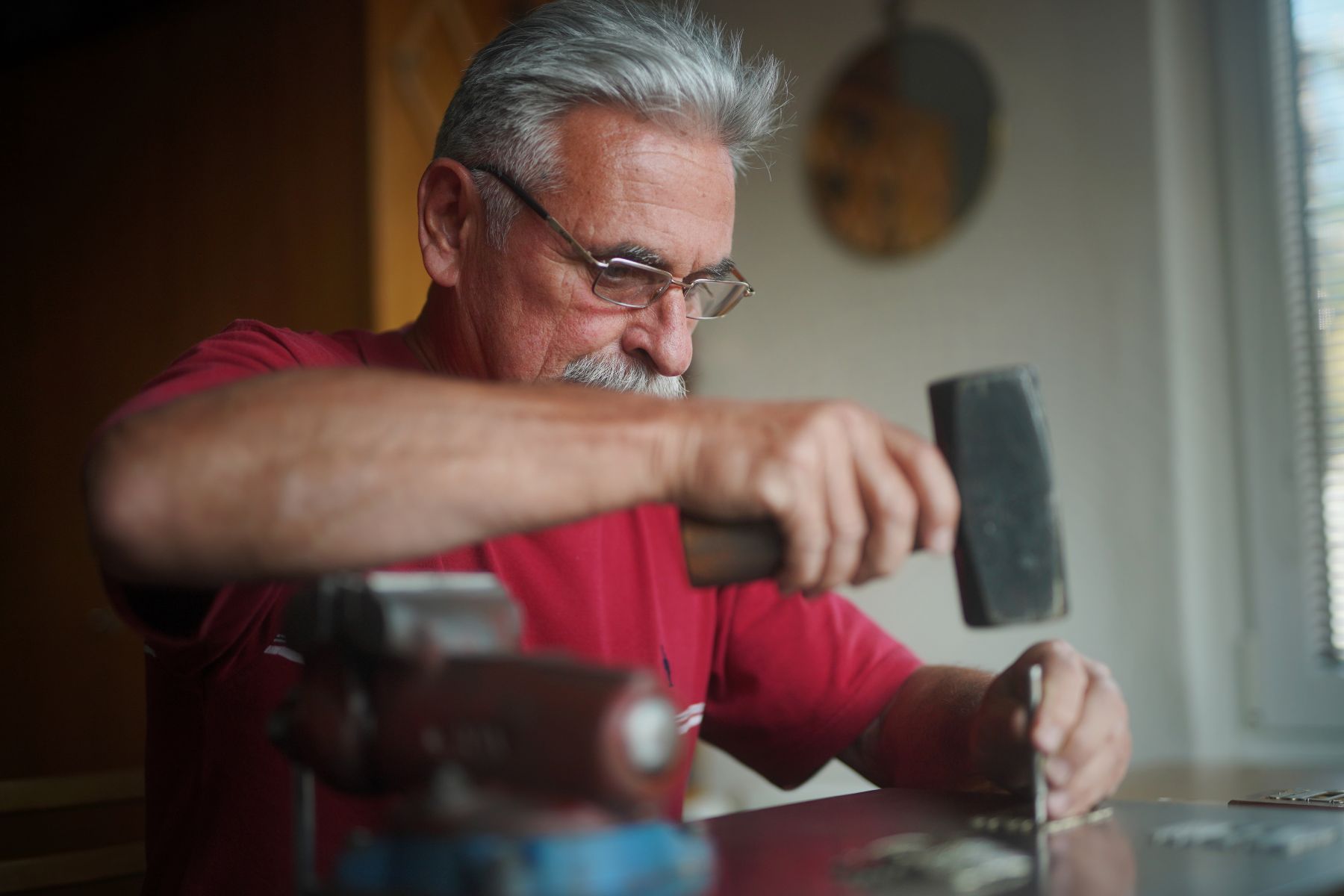
His wife sewed it for him, and he made the belt. He also became familiar with leather and its decoration by embossing as a toolmaker when he made metal punches for a friend. To test their sharpness, he asked his friend for leather scraps and tested them. He enjoyed this process so much that he began decorating belts himself. He already had experience in making buckles, so this step was a logical addition to the whole process of creating a traditional belt.
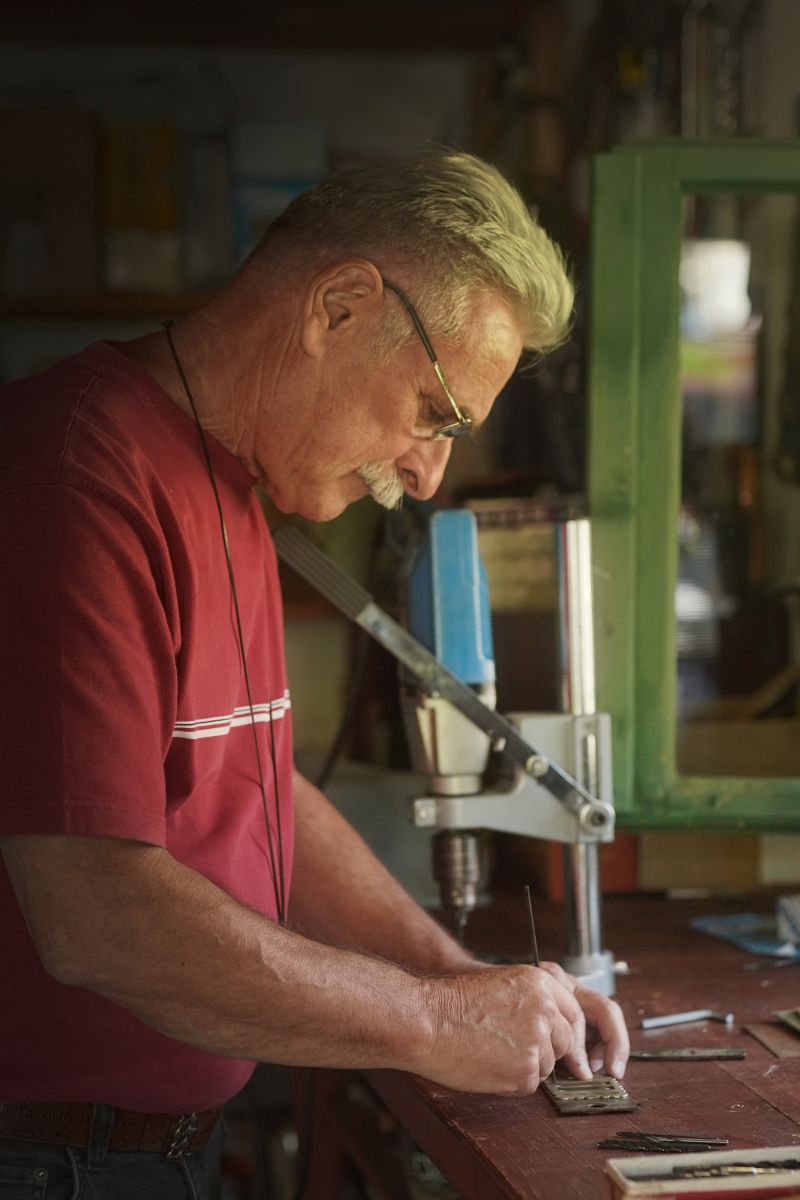
However, the first traditional metalworking technique he mastered was the production of drums. He knew this musical instrument, which is common to cultures on all continents, only by its sound. As an instrument maker, he wondered how it might be played. Then one day, a friend brought him one with a broken reed that he had at home. He repaired the reed, but at that time he did not have the necessary material, so he used a string from an alarm clock. While searching for materials, he also tried cutting sheet metal of a certain thickness, from which he “made” the necessary squares, until, over time, he found the right material – 4×4 mm spring steel and 0.5 mm thick spring steel for the reed. In the beginning, he made drumbles only for friends and acquaintances. However, after an exhibition in Východná, where he was approached by ethnographer Iveta Zuskinová, he discovered that people were interested in these instruments, and he began to devote himself to their production on a larger scale (to date, he has made more than four thousand drumbles). When making drumble, he uses various tools to facilitate his work, which he makes himself.
He is self-taught in metal and leather craftsmanship. Only in the case of whistles and fujaras, which he also makes, did he have a teacher – his neighbor Pavol Bielčik, who is a master of folk art production. He also came into contact with him through the local folklore ensemble, and it was thanks to this that he started making aerophones. As a good singer, he was invited to join a fujara trio, which needed someone to fill in. However, M. Moncoľ made it a condition that he would not buy a fujara, but would make one himself under the supervision of Pavel Bielčik. He is currently not involved in the production of aerophones, focusing his attention on drumble.
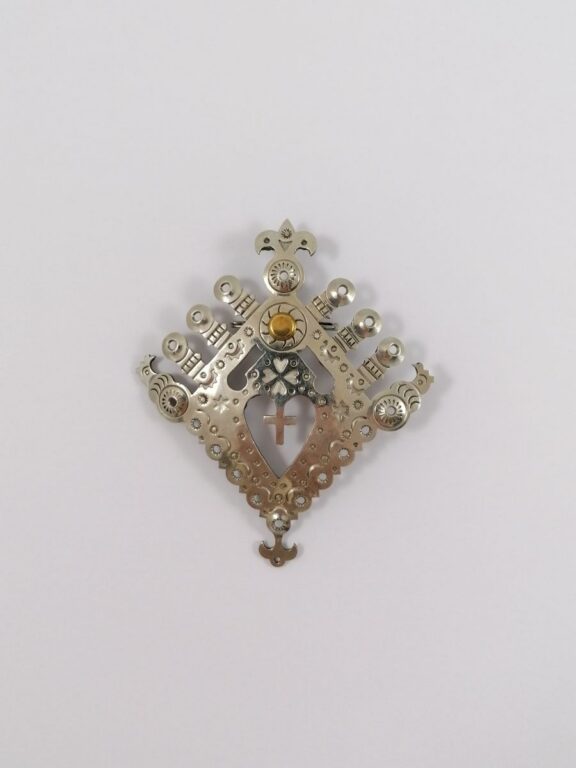
He is more or less self-taught in both metal and leather. He received advice a few times from the aforementioned master Jozef Lenhart from Bojnice, whom he first visited with Pavel Bielčik, and also from Samuel Švantner from Rimavská Sobota. He also likes to draw inspiration from books, such as the unique work Šperk by Helena Johnová from 1986, and in recent years also from the internet. However, he remains faithful to the local tradition in terms of decoration and the materials and techniques used, especially in the production of larger Kokava buckles. He cannot imagine any other pattern (typical mainly by the application of “snakes” – single- or double-headed or with a crown – or “trees”) on it, because it is precisely this that distinguishes it from other regional types, such as the very similar Gemer buckle.
He does not produce buckles separately, always with a strap. The reason is aesthetic – he does not want his buckles to appear on a poorly crafted belt. He wants to pass on his knowledge, and he sees Michal Beracko from Rimavské Zalužany as a promising prospect, to whom he has already explained several technological processes and principles of buckle production and belt decoration.
He regularly presents his craftsmanship at selected festival fairs (Východná, Detva, Hrušov, Kokava nad Rimavicou) and at the ÚĽUV Masters Days event in Bratislava. Abroad, he has presented his work in countries such as the Czech Republic, Hungary, Poland, Croatia, France, and Italy. In 2010, he received the prestigious Instrumentum excellens award for all types of instruments he makes – fujaras, whistles, and drumble. Similarly, in 2008, his collection of leather products, hair clips, drumles, and belts was awarded at the national exhibition Creative Interests of Man at the Liptov Museum in Ružomberok. His products are now part of museum and private collections at home and abroad.
When asked what keeps him going, he quotes his friend Pavel Bielčik: “If you don’t do anything, what’s the point of being in this world? He considers it equally important to preserve the legacy of previous generations of creators and performers, and perhaps the greatest incentive for him to continue creating is when people (especially children) enjoy his products.
In 2025, he was awarded the title of Master of Folk Art Production.