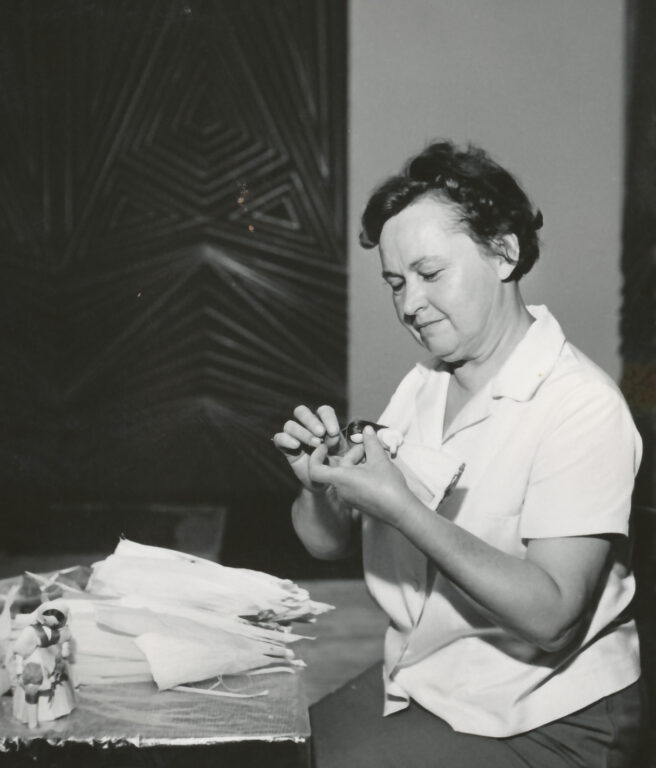
The name of this native of Dvorníky is associated with the beginnings of producing corn husk dolls in the ÚĽUV. Prior to that, she had experience making fabric dolls, although not on a large scale, as this topic only appealed to her when she was forty years old in 1955. She mainly composed dolls in group scenes, but also created...
The name of this native of Dvorníky is associated with the beginnings of producing corn husk dolls in the ÚĽUV. Prior to that, she had experience making fabric dolls, although not on a large scale, as this topic only appealed to her when she was forty years old in 1955. She mainly composed dolls in group scenes, but also created individual pieces, capturing life and work in the village (e.g. grape harvest, churning butter, etc.). As early as 1957, she drew the attention of the professional public to her work at the IV National Exhibition of Folk Creativity. Although she did not exceed the framework of amateur creation with her realistic portrayal, her dolls captivated with their dynamic and precise execution.
This drew the attention in 1958 to collaboration with the ÚĽUV, where, following the designs of the ÚĽUV artist Kamil Rauchovej-Ričlová, she reproduced souvenir fabric figures dressed in stylized costumes from various regions of Slovakia. Her work was of excellent quality, but the mass production did not suit her very well. So, K. Rauchová, who stood at the birth of the iconic corn husk dolls that made ÚĽUV famous in 1956, soon redirected her to their production.
The artist’s decision proved to be extremely foresighted. In a short time, she entrusted the production of cornhusk prototypes, as this type of doll came to be called, to a craftswoman. Moreover, after mastering the technological production process and solving the proportionality of the dolls, Serafína Pátková also proceeded to realize her own themes, drawing from everyday rural life, which she had carried within her since childhood.
She was the first to come up with the idea of creating a sitting doll, as well as capturing a doll in motion, which significantly enhanced the corn husk assortment. She made figurines of men, women, and children, preferably in group compositions. She became famous for her musicians, carolers, figures celebrating spring customs, and those working in the fields. She enriched the expression with various shades of naturally dyed material.
The relationship with her husband Jaroslav was important for her work. Not only did he understand and encourage her creativity, but from the beginning, he willingly complemented her compositions with miniature wooden chairs, spinning wheels, cradles, rakes, sickles, hatchets, and other objects from the traditional rural environment of the past, which sensitively complemented the dominating corn husks in the final shape.
Her products adorned the ÚĽUV shops as well as domestic and foreign exhibitions. Serafína Pátková enjoyed showcasing her art in public and through courses and instructions, where she trained many new artisans. She also appeared on television screens or in films demonstrating her production, and her work was often written about in newspapers and magazines. Her works can be found in the collections of several museums (Bratislava, Trnava, Martin).
Already in 1965, she was awarded the prestigious title of Master of Folk Artistic Production for the technical and artistic perfection of her products and for her merits in the development of corn husk doll production