Kesba – women’s winter clothing

Kesba – women’s winter clothing
Women’s festive attire in the winter period, Juniper, end of the 19th century. View from the back. The woman is wearing a long white woolen coat over a wide black velvet apron and a blue-print skirt. On her head, she has a large blue-print scarf with a green pattern, tied to the back of her cap. A blue-print scarf was always tied to the long white coat, never a white one. Under her right arm, the woman has a folded cloth sheet (apron) that women used to wrap themselves in in case of cold or rain. The sheet was worn in both summer and winter.
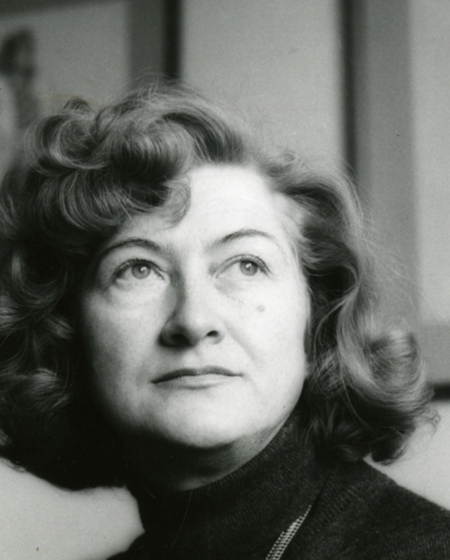

Viera Škrabalová-Líčeníková was a prominent Slovak textile artist with a wide range of creative activities. During her work at ÚĽUV, Viera Škrabalová-Líčeníková also engaged in fashion design. Her fashion sketches incorporate decorative elements of folk costumes, such as embroidery or lace, and are inspired by the design solutions of traditional folk clothing pieces. These drawings document the situation of the 1950s when ÚĽUV closely collaborated with embroidery, lace-making, and blueprint production cooperatives. This collaboration between the cooperatives and design studios resulted in several valuable models that also went into regular production.
The collection of drawings in the Museum of Folk Art Production includes mainly designs for women’s day and evening dresses, as well as blouses. The designs are accompanied by brief descriptions indicating the material, cut, and decoration of the garments. Natural fabrics were proposed for making the dresses – cotton, linen, and silk materials.
In addition to designing and implementing interior decorative and utility textiles, she was actively involved mainly in the spheres of theater, film, and television.

Viera Škrabalová-Líčeníková was a prominent Slovak textile artist with a wide range of creative activities. During her work at ÚĽUV, Viera Škrabalová-Líčeníková also engaged in fashion design. Her fashion sketches incorporate decorative elements of folk costumes, such as embroidery or lace, and are inspired by the design solutions of traditional folk clothing pieces. These drawings document the situation of the 1950s when ÚĽUV closely collaborated with embroidery, lace-making, and blueprint production cooperatives. This collaboration between the cooperatives and design studios resulted in several valuable models that also went into regular production.
The collection of drawings in the Museum of Folk Art Production includes mainly designs for women’s day and evening dresses, as well as blouses. The designs are accompanied by brief descriptions indicating the material, cut, and decoration of the garments. Natural fabrics were proposed for making the dresses – cotton, linen, and silk materials.
In addition to designing and implementing interior decorative and utility textiles, she was actively involved mainly in the spheres of theater, film, and television.